Explorar las categorías
Explora
Fiverr Pro
Español
$
USD

BRD to UI requirements, wireframes and design from one person
Habilidades
Revisa mis servicios

Business Analyst,Web Designer
SafalVir • Freelance
Jun 2026 - Aug 2026 • 2 mos
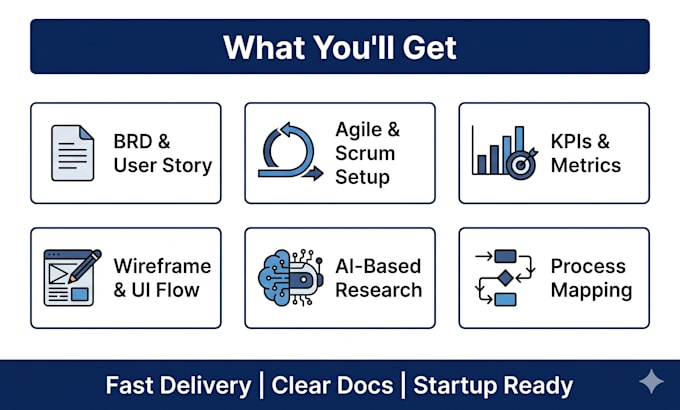
Safalvir — Multi-Product Design & Business Analysis Safalvir builds a portfolio of consumer and business platforms rather than a single product — AI agent-driven experiences, an RSVP and event management platform, B2C customer applications, and vendor management systems. I worked across all of them as both designer and business analyst. The core challenge was breadth. Each product served a different user with a different mental model: a guest confirming an invite, a consumer tracking purchases, a vendor managing operations. Building them in isolation would have produced four unrelated products from one company. Wearing both the BA and design hats added a second pressure — requirements and interface had to be resolved together, without the usual handoff to catch gaps. I approached this by working from the requirement layer outward. User flows, BRDs and user stories were mapped first, then translated directly into wireframes so logic and interface stayed in sync. A shared design language — type scale, colour system, component patterns — ran across every product, letting each one keep its own personality while reading as part of one family. For the AI agent work, where established UX patterns don't exist yet, I designed conversational-first entry with manual fallback, so users were never trapped in a chat when a form was faster. Vendor management was structured around role-based views, surfacing only what each role needed to act on. The result is a product suite that scales — new modules ship into an existing system instead of starting from zero.
