Explorar las categorías
Explora
Fiverr Pro
Español
$
USD
Shopify Expert, Pos Integration, Claude Code, Inventory Sync, Shopify Automation
Habilidades
Revisa mis servicios


Freelance • 1 yr 3 mos
Automation Developer
May 2025 - Jun 2026 • 1 yr 1 mo
Fieldstone worked with small and mid-sized businesses to automate repetitive operational tasks that were still being done manually, usually because no one on staff had time to set up the tooling themselves. I built Zapier-based automations connecting sales platforms, CRMs, and email tools for clients across home services, retail, and local hospitality. A typical engagement started with a process audit, sitting with a client's team to map exactly where manual data entry was happening and why, before building anything. From there I built multi-step workflows handling lead routing, appointment scheduling triggers, and follow-up sequences, along with failure-handling branches so a broken automation surfaced as a Slack or text alert rather than silently failing. I also ran short training sessions with client teams after each build so they understood what the automation was doing and could make basic edits themselves without contacting us for every small change. This role shaped how I still approach automation work today: build for the client's actual workflow, not a generic template, and always plan for what happens when a step fails.
Junior Web Developer
Jan 2026 - Feb 2026 • 1 mo
My first role out of school was building and customizing Shopify storefronts for small business clients at a digital agency, ranging from local boutiques to regional service businesses launching their first online store. I worked primarily in Liquid, HTML, CSS, and JavaScript, customizing themes, building custom sections, and integrating basic apps for reviews, email capture, and shipping calculators. Early on I was mostly executing designs handed off by senior developers, but within the first year I was running smaller client builds independently, including scoping requirements directly with business owners who often didn't know what was technically possible until we talked through it. I learned how much of freelance-style client work is translating a non-technical business need into a specific, buildable feature. This role gave me the foundation in Shopify's platform architecture that everything else in my career has built on, and it's where I first got comfortable being the only technical person in the room on a client call.
Shopify Systems Consultant
Aug 2024 - Sep 2024 • 1 mo
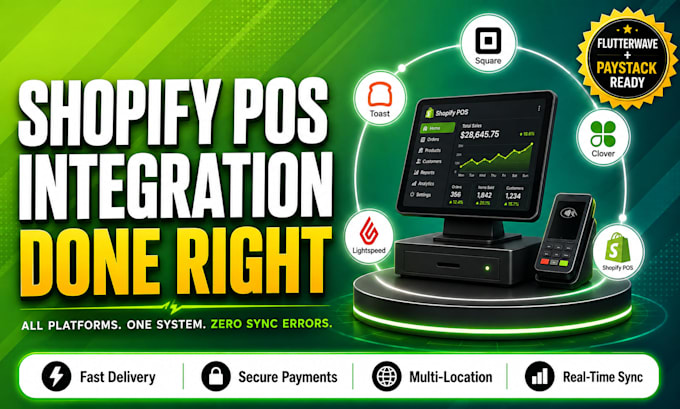
I work directly with retail and hospitality clients to connect their Shopify stores to the point-of-sale and back-office systems they already run in-store. Most engagements start the same way: a business has grown past manually reconciling online and in-store sales, and needs the two systems talking to each other without breaking daily operations during the switch. My work spans POS platforms including Toast, Clover, Lightspeed, and Loyverse, along with payment gateway setups covering Stripe, PayPal, Flutterwave, and Paystack depending on the client's market. I scope each project around the client's actual failure points rather than a generic integration template, since a five-location coffee chain and a single-location boutique need very different sync architectures. A typical project includes building or extending a middleware layer to bridge APIs that were never designed to talk to each other, setting up webhook-based real-time updates, and building lightweight internal dashboards so non-technical staff can monitor sync health without needing developer support. I also handle the handover documentation, since most clients maintain these systems internally after launch rather than keeping a developer on retainer indefinitely.
