Explorar las categorías
Explora
Fiverr Pro
Español
$
USD

I am abdulraheem a frontend developer and python developer
Habilidades
Revisa mis servicios
Aha Dynamics
Freelance • 1 yr 3 mos
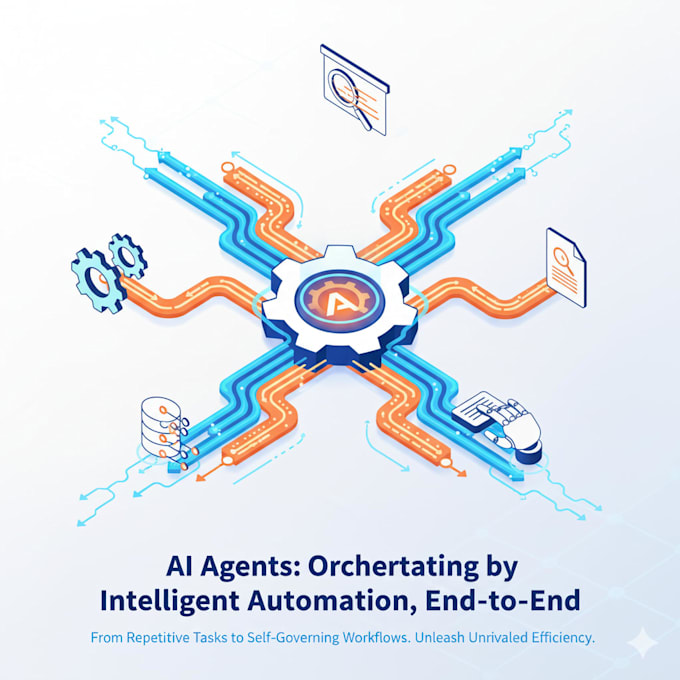
Designed Ai agents that can do specific tasks.
Apr 2025 - Present • 1 yr 1 mo
I have designed and developed AI agents tailored to perform specific, goal-oriented tasks, focusing on automation, reasoning, and real-world problem solving. My work involves building intelligent systems that combine large language models, task planning, tool usage, and decision-making logic to operate autonomously or semi-autonomously across different domains. I have created AI agents for bug fixing and developer assistance, capable of analyzing programming errors, scraping trusted knowledge sources such as Stack Overflow, and generating accurate, actionable fixes. These agents integrate natural language understanding, web automation, and code analysis to reduce debugging time and improve developer productivity. In addition, I have designed multimodal AI agents that process and reason over both text and images, enabling tasks such as image-to-text generation, visual understanding, and contextual captioning. These systems demonstrate how vision and language models can work together in a unified pipeline for advanced AI applications. I have also developed AI-powered healthcare and safety agents, including an AI medical therapist designed to provide empathetic support, assess emotional risk, locate nearby professionals, and escalate emergencies when self-harm indicators are detected. These systems are built with a strong emphasis on ethical AI design, user safety, and responsible deployment. My experience includes working extensively with PyTorch, implementing models from scratch, integrating pretrained weights, fine-tuning models for custom use cases, and building modular, production-ready pipelines. I focus on writing clean, well-documented code and designing agents that are scalable, explainable, and easy to integrate into existing platforms such as IDEs, web applications, or APIs.
Stable Diffusion 1.5 – PyTorch From Scratch
Sep 2025 - Oct 2025 • 1 mo
This project presents a complete PyTorch implementation of Stable Diffusion 1.5, developed entirely from scratch to provide a transparent and educational view of how modern diffusion-based generative models work. Instead of relying on black-box libraries, every core component is implemented manually, making the project ideal for deep learning practitioners who want full architectural clarity and customization control. The implementation faithfully reproduces the full Stable Diffusion pipeline, including the UNet denoising network, Variational Autoencoder (VAE) for latent space encoding/decoding, and CLIP text encoder for prompt conditioning. The project supports loading official pretrained weights, enabling high-quality text-to-image generation while still allowing experimentation, fine-tuning, and architectural modification. The codebase is clean, modular, and well-documented, making it suitable for research, learning, and production prototyping. Users can easily trace how text prompts are converted into embeddings, how noise is progressively removed during sampling, and how latent representations are decoded into final images. This project is especially valuable for researchers, students, and developers interested in diffusion models, generative AI, and representation learning. It also serves as a strong foundation for extending Stable Diffusion with custom datasets, schedulers, optimizations, or fine-tuning strategies. Key Highlights: Full Stable Diffusion 1.5 architecture in PyTorch Pretrained weights loading and inference support Text-to-image generation pipeline Modular and extensible design Ideal for learning, research, and customization
LLaMA 2 – PyTorch Implementation
Aug 2025 - Sep 2025 • 1 mo
This project provides a PyTorch implementation of LLaMA 2, Meta’s powerful large language model designed for text generation, reasoning, and instruction following. The project focuses on architectural transparency, modular design, and practical usability for both learning and experimentation. The implementation includes the full transformer architecture, featuring self-attention, rotary positional embeddings, layer normalization, and efficient token processing. It supports pretrained weight loading, enabling users to run inference or adapt the model for downstream tasks such as chatbots, summarization, or domain-specific fine-tuning. Special attention is given to code clarity and documentation, making it easy to understand how large language models process tokens, manage attention, and generate coherent outputs. The project is suitable for developers and researchers who want hands-on experience with modern LLM internals rather than relying solely on high-level APIs. This implementation serves as a strong foundation for NLP research, instruction tuning, and custom deployment scenarios. It is ideal for experimenting with scaling behavior, prompt engineering, fine-tuning strategies, and performance optimizations in large transformer models. Key Highlights: Full LLaMA 2 transformer architecture in PyTorch Pretrained weight integration Tokenization and inference pipeline Clean, modular, and extensible codebase Suitable for research, learning, and real-world NLP tasks
